























For more than a decade, lutenists looking for real gut basses found a closed door: Aquila had stopped making its loaded gut strings. In 2026 they are back, and you can now find them at Cuerdas Pulsadas.
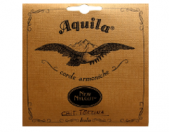
They are the Aquila Loaded Gut Basses CC: lamb-gut basses loaded with copper powder, made for lutes, theorbos and viols.
A three-hundred-year-old problem
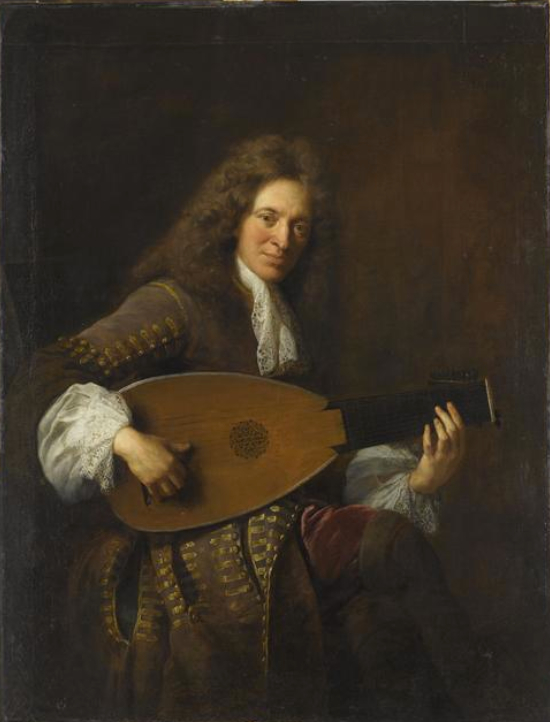
François de Troy, Portrait of Charles Mouton (c. 1690), Musée du Louvre. Public domain.
In 1676 Thomas Mace wrote about a special kind of bass:
“…there is another sort of strings, which they call Pistoy basses, which I conceive are none other than thick Venice-Catlins, which are commonly dyed, with a deep dark red colour.”
Mimmo Peruffo, founder of Aquila, put the clues together: the bass holes of surviving lute bridges are too narrow for plain gut, and many paintings of the period show dark, brown or red basses. His hypothesis is that old string makers made gut denser by loading it with metal powders, so that a thinner string could sound a lower note. He published it from 1991 onwards and updated it in 2018 after measuring the bridges of about a hundred historical lutes.
What the Aquila CC are
CC strings are whole lamb gut densified with metallic copper powder, which roughly doubles their specific weight. They contain no lead or mercury compounds. They are the gut counterpart of the well-known synthetic Aquila Loaded Basses CD, which use the same copper loading.
The sound is full and rich, centred on the fundamental, and it blends with gut trebles without the change of colour wound strings sometimes bring. They even allow the bass courses to be strung in unison, as John Dowland recommended in 1610.
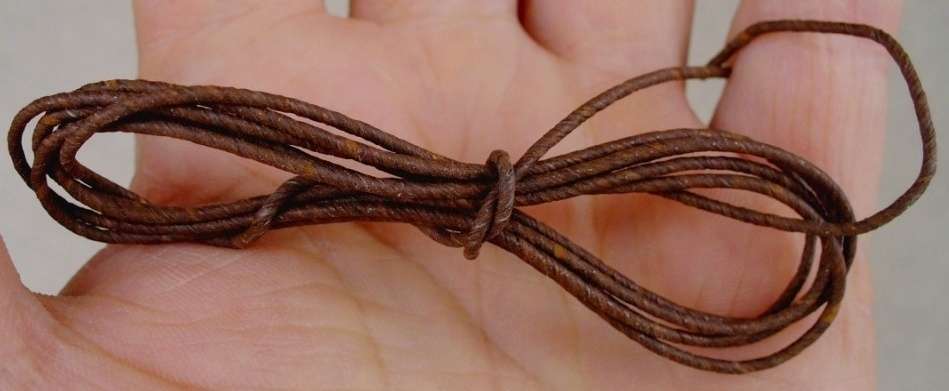
Photo: Aquila Corde Armoniche
Which instruments
- Renaissance lutes of 7 to 10 courses.
- 17th-century short-scale 12-course Dutch lutes, and 11-course D-minor lutes.
- The fretted basses of Italian liuti attiorbati and of theorbos (6th–8th strings).
- Viols from before wound strings (c. 1670–80), especially short-scale copies, viola bastarda and lyra viol.
They are for basses only: not recommended for the 1st–3rd strings of viols, the 4th course of a Renaissance lute, the 5th course of a D-minor lute or the 3rd–4th strings of a theorbo, nor as cello basses.
A line with a long history
- 1990–1995: an Italian patent application for strings loaded with metal powders, with Peruffo as inventor, and European patent EP0482515 (filed 1991, granted 1995).
- 1993: Jakob Lindberg records La Serenissima II (BIS) with Aquila loaded gut basses.
- Type C: Aquila made them varnished and reddish-brown; in 2008 it dropped the varnish and made them more elastic.
- Around 2013: production stops.
- 2026: Aquila makes them again as Loaded Gut Basses Type CC.
Our shop carries ten gauges, from 1.00 to 2.00, in 120 cm, with the actual-diameter table and every detail on the category page.