















Vihuela strings
«en solo el dedo, como en cosa biua cõsiste el verdadero spiritu, q̃ hiriẽdo la cuerda se le suele dar»
“in the finger alone, as in a living thing, lies the true spirit that is given to the string in striking it”
(Miguel de Fuenllana, Orphénica lyra, Seville 1554, “De los redobles”)
The vihuela de mano was the plucked instrument of 16th-century Spain, with a repertoire printed between Luis Milán’s El Maestro (1536) and Esteban Daza’s El Parnaso (1576). The vihuelists wrote about their strings: how thick the treble should be, how high to tune it and how to tell a good gut string from a false one. On this page you will find their advice, what each course uses today, the string makers’ recommendations and the lines in our shop.
Six courses, two octaves
Milán opened El Maestro with a woodcut of Orpheus playing the vihuela, “the first inventor” of the instrument. Twenty years later the friar Juan Bermudo described it in his Declaración de instrumentos musicales:
«LA vihuela cõmun tiene seys ordenes de cuerdas: las quales se llaman sexta, quinta, quarta, tercera, segunda, y prima. Esta vihuela en vazio, sin hollar traste alguno tiene desde la sexta hasta la prima vna quinzena, que son dos diapassones, o dos octauas.»
“The common vihuela has six courses of strings, called the sixth, fifth, fourth, third, second and treble. Played open, without stopping any fret, it spans a fifteenth from the sixth to the treble, that is, two diapasons or two octaves.”
(Juan Bermudo, Declaración de instrumentos musicales, Osuna 1555, book II, ch. 31, fol. 28r)
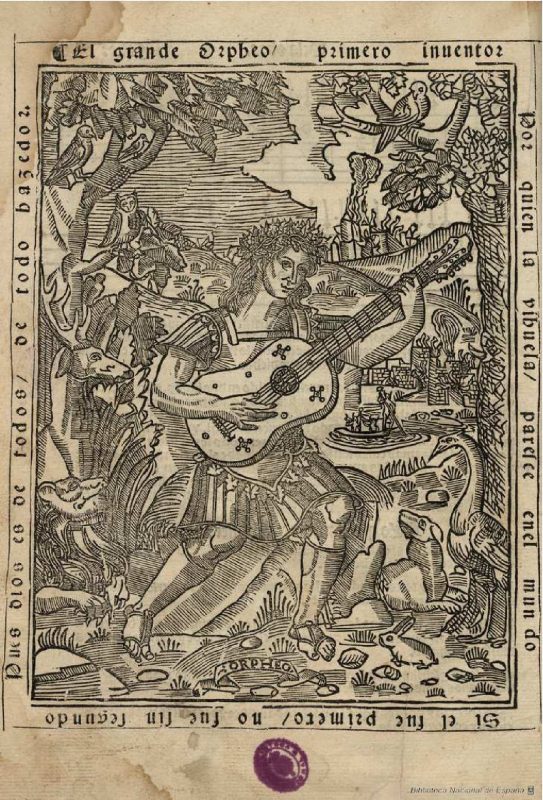
Orpheus playing the vihuela, woodcut in Luis Milán, El Maestro, Valencia, 1536, fol. A6v. Biblioteca Nacional de España.
Tuning and pitch
The courses are tuned in fourths with a major third between the 4th and the 3rd, the same intervals as the Renaissance lute: Bermudo calls it “the common tuning used in Spain”. Today vihuelas are usually tuned in G (g′ d′ a f c G) or in A, and makers also sell sets in F and E. The vihuela had no fixed pitch: Milán tells the player to choose the treble by the size of the instrument and to tune it as high as it will bear, then tune the other courses from it. Bermudo adds that the five-course guitar of his time is “nothing but a vihuela with the sixth course and the treble taken away”; see our baroque guitar guide.
«Si la vihuela es grãde / tenga la prima mas gruessa que delgada. Y si es pequeña / tenga la prima mas delgada que gruessa: y hecho esto / subireys la prima tan alto quanto lo pueda suffrir: y despues templareys las otras cuerdas / al punto dela prima»
“If the vihuela is large, give it a treble rather thick than thin; if it is small, a treble rather thin than thick. When this is done, raise the treble as high as it will bear, and then tune the other strings to the pitch of the treble.”
(Luis Milán, El Maestro, Valencia 1536, “Declaración del libro”, fol. iii v)

The vihuela with the sol-fa intervals for tuning it, Luis Milán, El Maestro, Valencia, 1536, fol. iiij.
Gut trebles and the test of a true string
The vihuela was strung in gut, and the trebles and middle courses are still plain strings today: gut, or synthetic gut for stability in changing weather. A false string, uneven along its length, will not play in tune on the frets, and Milán explains how to spot one before fitting it:
«Estirareys con dos dedos de cada mano la cuerda de vihuela: la qual ha de ser de largaria dela vna pontezica hasta la otra justo. Y assi estirada / darle eys con otro dedo / como quien la quiere tañer: y si la dicha cuerda haze como que son dos cuerdas es buena: y si haze como que son mas de dos cuerdas / es mala: y no se deue poner enla vihuela.»
“Stretch the vihuela string between two fingers of each hand, at exactly the length from one little bridge to the other. Holding it stretched, pluck it with another finger as if you were playing it. If the string looks like two strings, it is good; if it looks like more than two, it is bad and must not be put on the vihuela.”
(Luis Milán, El Maestro, Valencia 1536, fol. iii v – iiij r)
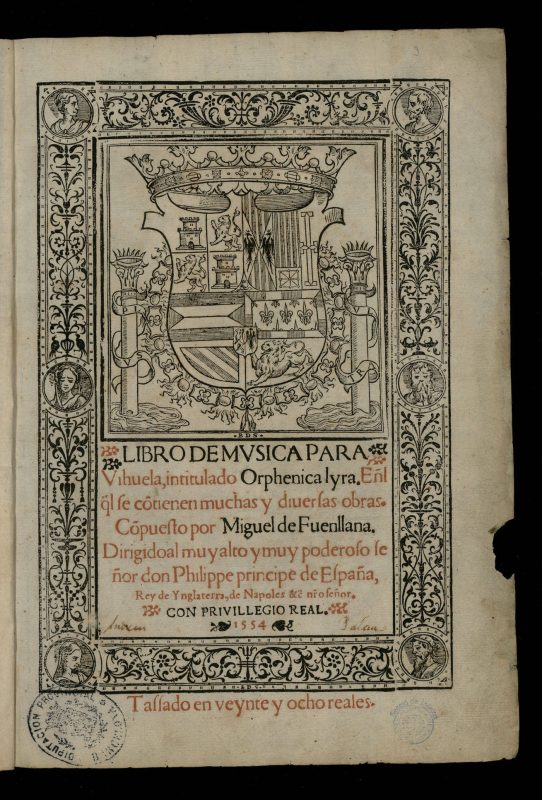
Miguel de Fuenllana, Orphénica lyra, Seville, 1554, title page. Biblioteca de Catalunya.


Basses, octaves or unisons
The 5th and 6th courses (and the 7th on seven-course vihuelas, which Bermudo describes and drew) need basses: loaded or wound strings, or gut catlines for an all-gut setup. Each bass course can be strung in unison or with an octave string; the string makers offer both, and the choice is the player’s. The octave string is always a plain string, never lower in tension than the bass it is paired with.
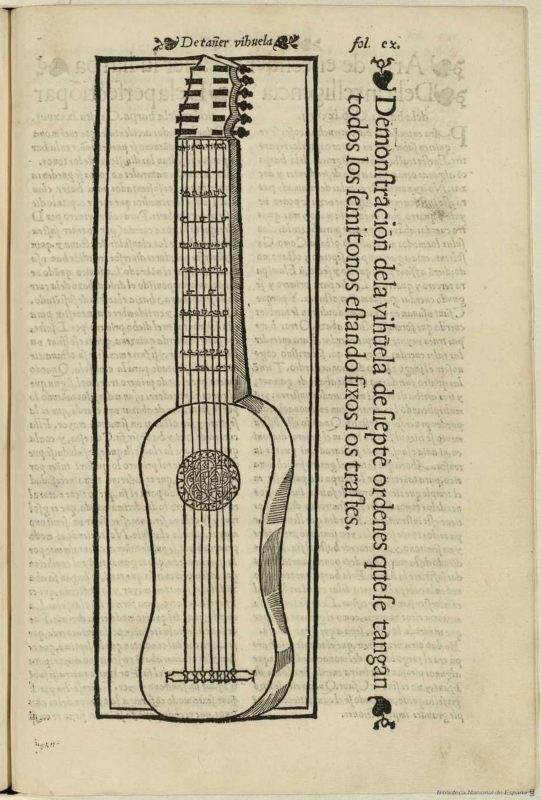
“Demonstration of the seven-course vihuela”, Juan Bermudo, Declaración de instrumentos musicales, Osuna, 1555, fol. 110r. Biblioteca Nacional de España.


Frets
The frets are tied gut, usually in gauges that decrease from the nut towards the body. Bermudo warned that a course which is in unison open but not when stopped has a bad string in it, unless the fret is uneven or the finger does not press evenly:
«Son estas cuerdas semejantes alos christianos malos de secreto, que no parece su maldad: hasta que les ponen la mano encima»
“Such strings are like secretly wicked Christians, whose wickedness does not show until a hand is laid on them”
(Juan Bermudo, Declaración de instrumentos musicales, Osuna 1555, book IV, ch. 82, fol. 107v)


Straps by La Rossignol
The straps made by La Rossignol for early music instruments are entirely handmade, from start to finish by one person, in limited editions. Each design is named after a composer. For the vihuela we recommend the narrow 3.8 cm strap; the wide 5 cm one is meant for large instruments such as the theorbo.

Francesco Spinacino

La Rossignol

La Rossignol

Adrian Le Roy

La Rossignol

John Dowland

Gaspar Sanz
What the string makers recommend
Kürschner and Pyramid publish vihuela stringings; Aquila does not publish one for the vihuela. As a starting point, for a vihuela in G of 60–63 cm, courses 1 to 6 of Aquila’s Renaissance-lute recommendations on our lute strings page have the same intervals (this is our reading, not Aquila’s advice).
| Topic | Recommendation | Maker |
|---|---|---|
| Vihuela in G, 60 cm | Plain gut for the trebles and middle courses, wound basses; tension 37 / 33 / 31 / 29 N on courses 1–4 and 29 or 27 N on the bass courses (about 3.8 to 2.8 kg), unisons or octaves on the bass courses. | Kürschner |
| Sets for 55–65 cm | In A, G, F or E, six or seven courses, with or without octaves on the bass courses; about 3.4–3.5 kg per string on a 59/60 cm vihuela. | Pyramid |
| Octave strings | Use gut, nylon or New Nylgut for the octaves, never a wound string, and never give the octave less tension than the bass it is paired with. | Aquila |
| Working tension | There is no formula for the right tension: strings should feel neither too tight nor too loose under the right hand. Find the tension you like on one course, trying a semitone higher and lower; then scale the other courses rather than giving them all the same tension, and repeat the test if you change string type. | Aquila |
Choosing gauges
The right gauge depends on the vibrating length of your vihuela, the pitch and the tension you prefer. Our string calculator works out tensions and gauges in any material, and the tools page has equivalence and diameter tables across makers. Remember that each maker numbers differently: Aquila by equivalent gut diameter, Savarez NFC by weight per unit length and Pyramid by article number. If in doubt, write to us with your vibrating lengths and the strings you use now.
String calculator and tools Contact usVihuelas for sale in our instrument market



Frequently asked questions
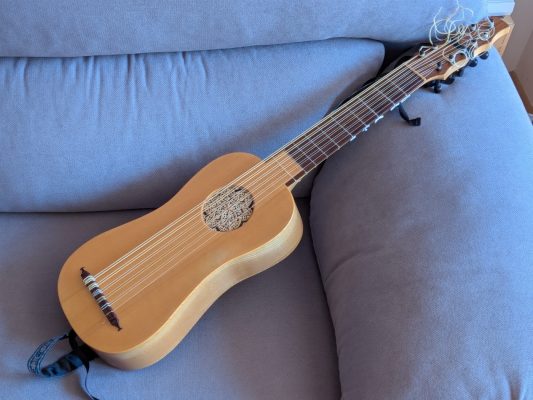
Six courses, usually double: twelve strings, or eleven when the treble is a single string, as many players use it today. Seven-course vihuelas also existed.
Gut gives the historical sound and feel but reacts to humidity; Aquila’s New Nylgut is more stable, and Aquila suggests a slightly thicker gauge than in gut. Many players mix them, with gut trebles and synthetic or loaded basses.
Both are used today and the string makers sell both; the choice is the player’s, so try both on your instrument. The octave string is always a plain string.
It depends on the size of the instrument and on the music. G is the most common today; small vihuelas go up to A, large ones down to F or E. Milán’s rule still works: the treble as high as it will bear.
Sources
- Luis Milán, Libro de música de vihuela de mano intitulado El Maestro, Valencia, 1536, “Declaración del libro” (quoted from a facsimile of the print).
- Miguel de Fuenllana, Libro de música para vihuela intitulado Orphénica lyra, Seville, 1554, “De los redobles” (Biblioteca de Catalunya copy).
- Juan Bermudo, Declaración de instrumentos musicales, Osuna, 1555, book II ch. 31–32 and book IV ch. 82 (Biblioteca Nacional de España copy).
- Kürschner, “Vihuela” string chart, kuerschner-saiten.de.
- Pyramid, strings for historical instruments (catalogue), “Vihuela”, pyramid-saiten.de.
- Aquila Corde Armoniche, “Renaissance and baroque lute” (string recommendations), aquilacorde.com.